
As part of the implementation of the Regional Agricultural Policy (ECOWAP) and the regional strategy for livestock development and securing pastoral systems in West Africa and the Sahel, the ECOWAS Commission has received a financial grant of eighteen (18) million euros from the French Development Agency (AFD) to implement two flagship regional projects for the sector.
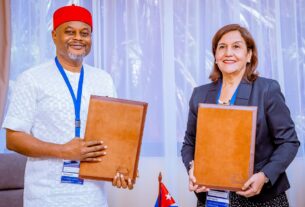
A statement from the French Embassy in Abuja said these projects, which was launched by the President of the ECOWAS Commission, H.E. Dr Omar Alieu Touray, together with the French Ambassador to Nigeria and to ECOWAS, H.E. Marc Fonbaustier, and the AFD Country Director in Nigeria, Mr. Jacky Amprou, cover the thematic areas of promoting local milk and the strengthening of the resilience of livestock systems in West Africa and the Sahel.
“The first grant goes to the West Africa Milk Offensive Support Project (PAOLAO), which falls within the implementation of the regional strategy for promoting local milk value chains in West Africa, known as the ‘Milk Offensive’, adopted in 2020. Milk is one of the five strategic products for food security and sovereignty identified by the Regional Agricultural Policy, given its economic and socio-cultural importance in the region.
“The region’s objective is to maximise its enormous potential to double its production volume by 2030, on the one hand, and to increase processing and consumption by raising the incorporation rate of local milk to between 20 and 25 per cent by 2035, on the other.
“Scheduled for five years (2023-2028) with a total budget of €11 million, for which the financing agreement was signed in May 2024, PAOLAO aims to contribute to a significant reduction in imports of dairy products enriched with vegetable fats, on the one hand, and to create conducive conditions for youth employability, on the other. Specifically, it aims to (i) support ECOWAS in leading the implementation of the dairy sector strategy, (ii) support the structuring of the local dairy sector, (iii) promote the consumption of local milk, and (iv) initiate a dialogue for greater mobilisation and commitment from technical and financial partners in favour of the sector. The project plans to directly support fifteen (15) local collection initiatives and nine (09) mini projects promoting quality labels in the region.
PRESS RELEASE
Livestock Farming in West Africa (PEPISAO II) between the ECOWAS Commission and AFD. With a budget of €7 million, PEPISAO II will consolidate the positive results achieved during its first phase which ended in late 2024. Phase 2 (2025-2029) aims to contribute to social cohesion, development, climate resilience and the resolution of territorial conflicts in West Africa and the Sahel by operationalising the Regional Strategy for Livestock Development and Securing Pastoral Systems, as endorsed by the Nouakchott+10 Declarations of November 2024, and approved by all West African and Sahel countries.
Both projects reinforce the efforts made by the ECOWAS Commission to fully take advantage of the economic, social and environmental potential of livestock farming systems in general and pastoral farming in particular.
The contribution of the French Development Agency, which also acts as lead donor for ECOWAP, comes at a crucial time for regional integration in West Africa. Livestock farming systems are not only the backbone of food and nutrition security for populations, but also the second largest source of intra-community trade in local products. They facilitate the densification of regional economies through the operation of numerous livestock markets, collection centres and mini dairies, thereby contributing to strengthening the resilience of populations.
Any action that contributes to consolidating and securing the foundations for the development of the livestock sub-sector and making it a source of decent jobs and income for young people, and a tool for strengthening social cohesion among communities in line with the current ECOWAS vision of “An ECOWAS of the Peoples, Peace and Prosperity for All by 2050”, is strongly encouraged in the current context of security, economic and socio-political crises.